
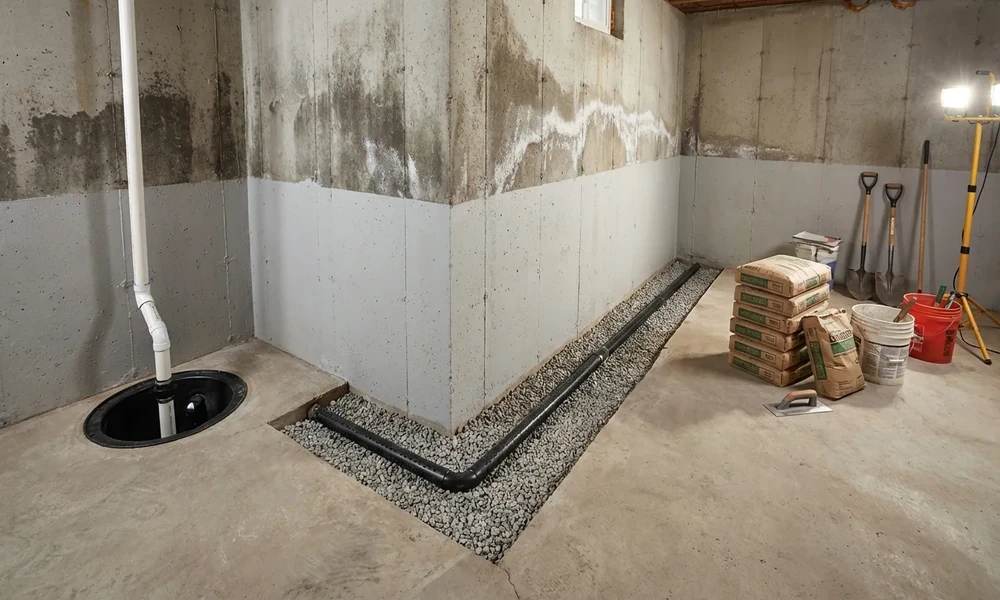
A house sitting high on a ridge outside Danbury seems like the last place to find a wet basement. There is no river nearby, and the street drains away in every direction. Yet every April the same homeowner finds a dark ring creeping across the floor along one wall. The cause is not the weather so much as what the last ice sheet left behind under the lawn.
Most of western Connecticut and the Hudson Valley counties next door sit on soil shaped by glaciers, and that soil moves water in ways that surprise people who moved here from somewhere else. Leaks tend to follow a small set of predictable paths, and once you know which one your house is dealing with, the fix stops being guesswork.
That diagnosis is the first thing a free inspection from All Dry Basement Systems sets out to answer. The Danbury company has spent more than 15 years working on homes across the western half of the state along with Westchester, Putnam and Dutchess counties, and it is licensed and insured. Its work runs from interior and exterior French drains, sump pumps and dry wells to foundation crack repair, crawlspace encapsulation and gutter extensions, which covers most of the paths described below.
1. Dense Till Turns the Foundation Trench Into a Bathtub
Till is the most common glacial deposit in the state. The USGS Surficial Materials Map of Connecticut describes it as an unsorted mix of sand, silt and clay packed with stones and boulders, laid down directly by glacier ice. In many spots it is compacted so tightly that water barely moves through it.
Now picture a builder digging into that till, pouring a foundation, and backfilling the gap with looser soil. The backfill drains well. The till around it does not. Rain soaks into the soft ring of soil hugging the house and then has nowhere to go, so it sits against the walls like water in a tub. That is why hilltop homes leak. The water collects beside the foundation because the ground beyond refuses to take it.
2. Ledge Below Sends Water Sideways
Bedrock sits close to the surface across much of Fairfield and Litchfield counties, and locals simply call it ledge. Water that soaks down through the soil eventually hits that rock and starts running along its surface, following the slope of the stone rather than the slope of the yard.
Homes built on or near ledge often see water show up at the joint where the floor meets the wall, or through the floor itself, rather than through the walls. Where builders blasted rock to make room for a basement, the fractured stone can act like a buried channel feeding water straight to the slab.
3. Hillside Lots Carry Groundwater Downhill Underground
On a sloped lot, groundwater travels downhill beneath the surface just as runoff does above it. The uphill wall of the basement takes the brunt. One wall often stays damp while the others stay dry, and the problem peaks during snowmelt and heavy spring rain, when the ground is saturated and the water table climbs.
This kind of seepage often stops on its own by midsummer, which convinces people the problem has gone away. It returns every spring because the water is still moving downhill toward the house.
4. Valley Soils Raise the Water Table Under the Slab
Not every home sits on till. Along stream valleys and near lakes and reservoirs, the ground is usually made of sand and gravel left by glacial meltwater. These soils drain quickly, but they also hold a high water table that rises and falls with the seasons.
When that water table climbs above the basement floor, pressure pushes water up through floor cracks, around plumbing penetrations and through the floor and wall joint. Sealing the inside surface rarely works here, because the water is pushing from below with real force.
5. Old Foundations Have Their Own Weak Points
The region’s housing stock adds another layer. Each era of foundation tends to fail in its own way.
- Fieldstone foundations in older farmhouses and village homes rely on mortar that slowly washes out, opening gaps between stones.
- Concrete block walls from the middle of the last century can fill with water in their hollow cores and release it through the lowest course.
- Poured concrete in newer homes usually leaks through shrinkage cracks, tie rod holes and the floor and wall seam.
6. Roof Water Lands in the Worst Possible Spot
A single inch of rain on a modest roof produces hundreds of gallons of water, and the downspouts drop all of it right next to the foundation. On glacial soil that means pouring water directly into the soft backfill described in the first section. Short downspouts, clogged gutters and soil that has settled until it slopes toward the house can turn a minor seepage issue into a steady leak.
Matching the Fix to the Path
Because each path behaves differently, the solution should follow the source rather than the symptom.
| Where the water comes from | What usually addresses it |
|---|---|
| Saturated backfill against walls | Exterior French drain, regrading, interior perimeter drain with a sump pump |
| Water running along ledge | Interior drainage at the floor and wall joint feeding a sump |
| Uphill groundwater on a slope | Exterior or curtain drains intercepting water before it reaches the house |
| High water table in valley soils | Interior perimeter drain and sump pump with battery backup |
| Cracks in poured concrete | Crack injection, paired with drainage if pressure is high |
| Roof runoff at the foundation | Gutter repair, downspout extensions or a dry well |
Many basements deal with two or three of these at once, which is why one patch often just moves the leak elsewhere.
Reading the Clues Before the Next Storm
The basement itself usually tells the story. White, chalky efflorescence on walls shows where water has been passing through and evaporating. A tide line along the base of a wall points toward saturated soil or a rising water table. Musty air with no visible water may mean humidity coming through the slab, which a dehumidifier or encapsulation of a connected crawlspace can help with. Rust on appliance legs and peeling paint along the bottom of drywall tell the same story.
The best time to look is late winter into spring, right after a stretch of rain or melting snow. That is when glacial ground holds the most water, and when the path into your basement is easiest to trace.